
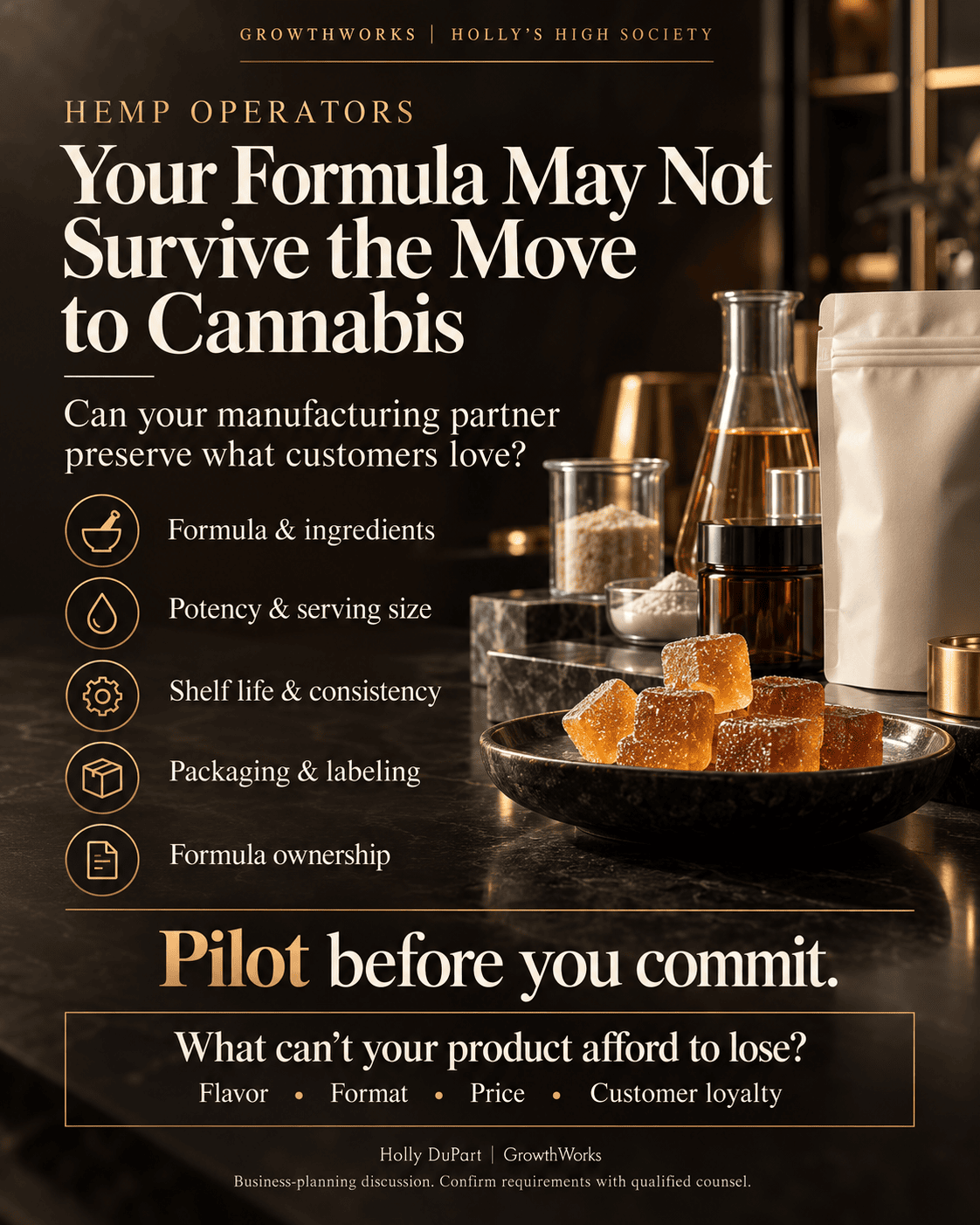
You found a manufacturer. You discussed the minimum order quantity. Now comes the question that sounds
simple but may not be: can they actually make your product?
For hemp operators transitioning products into Illinois’ regulated cannabis market, I would not assume an
existing formulation can simply be handed to a cannabis manufacturer and reproduced exactly as it exists
today. The process, cannabinoid inputs, potency and packaging may need to change. Every change can affect
the thing that matters most: will your customer still want the product?
Illinois’ new hemp framework takes effect November 12, 2026. Products classified as cannabis will be subject
to the regulated cannabis system; a manufacturer should review each proposed product against the applicable
requirements before development begins. [1] For operators choosing that path, this may be a product
redevelopment project.
Your existing formula is the starting point
are part of the value you have built. A new manufacturer might use a different pectin, flavoring system, cannabis input,
gummy? Before development begins, write a product brief identifying what must stay consistent and what can change.
Include the recipe and process information you can share, allergen requirements, desired serving size, package
format and target cost. Make the acceptance criteria clear enough that both sides know what an approved
sample should achieve.
Potency and ingredients affect the whole product
Illinois’ cannabis packaging statute limits cannabis-infused products intended for consumption to 100 mg THC
per package. Review serving requirements and applicable rules with the licensed manufacturer rather than
assuming the existing hemp dose transfers unchanged. [2]
How many servings belong in the package? Will a different cannabinoid input change taste or texture? Can the
manufacturer maintain consistent distribution throughout the batch?
Review every ingredient, not just the cannabinoids: sweeteners, colors, flavorings, preservatives, stabilizers,
coatings and functional ingredients. The question is both whether the proposed product is permitted and
whether this manufacturer can reliably make it at commercial scale.
Shelf life deserves its own test
A product may taste excellent when it leaves the line. What happens after 60 days, or after six months? Does it
sweat, separate, dry out, change color or lose flavor? Does the package protect it during storage and
transport? Ask what evidence supports the proposed shelf life and which stability checks will be performed. A successful
batch must remain suitable for sale long enough to move through the planned retail channel. A passing release
test alone does not answer every shelf-life question.
Packaging can change the economics
Illinois cannabis packaging and labeling requirements include child-resistant features and required product
information. [2] Your current hemp package should therefore be reviewed before you order another large
quantity. The review may affect label space, serving information, package size, closures and case packs. These changes
affect cost, shelf presence and customer recognition. Get the packaging specifications approved before
printing, and identify who is responsible for artwork review, sourcing and delivery.
Ask who owns the new formula
Suppose you bring a recipe to a manufacturer and their developer modifies it. You pay for several rounds of
development and eventually approve a new product. Who owns the result?
Your agreement should distinguish your original intellectual property from the manufacturer’s existing base
formulas and newly developed work. Ask whether you can move the formula to another manufacturer and
what documents or process instructions you would receive. Have counsel address confidentiality, permitted
use and what happens when the relationship ends.
Pilot before you commit
Agree on the development stages before placing a commercial order: formula review, sample, pilot batch,
testing, packaging review and approval. Define who pays for trials and what happens when a sample fails the
agreed specifications. Where lawful and appropriately arranged, feedback from adults familiar with the
original product can help assess whether the new version preserves what customers value. Spark could eventually
support structured consumer research, with permissions and compliant arrangements established first.
Packaging and preference research can also happen without product consumption.
Feedback helps guide decisions; it should not be presented as a guarantee of sales or as proof that effects will
be identical.
Preserve what made customers return
You do not need to preserve every detail of the old product. Redevelopment may improve it. But know what
you are protecting before the work begins: flavor, format, price, brand recognition or another part of the
experience. Through GrowthWorks, we’re exploring how product briefs, manufacturer matching, development
coordination and launch planning can fit together. There is a great deal between having a recipe and having a
product ready for commercial production. If you have an existing hemp product you hope to transition,
what is the one thing about it you cannot afford to lose? Send me your product category and the
customer experience you want to preserve.
GrowthWorks | Holly’s High Society
This article is for business-planning discussion and is not legal advice. Confirm product, licensing, manufacturing and sales requirements
with qualified counsel and the appropriate Illinois agencies.
Sources
[1] Illinois Hemp Act 410 ILCS 707 effective November 12 2026
[2] Cannabis product packaging and labeling 410 ILCS 705 Section 55 21
Regulatory references checked October 7, 2026. Review current law and agency guidance before scheduled publication.